80% of people pick up their phones first thing in the morning. Imagine, one day, just like any other, you pick your phone up and text your best friend. But nothing works… No WhatsApp, no Snapchat, no Instagram. You figure it’s just a WiFi problem, so you continue to go about your day. You head to the car and switch on the GPS to get to school, but no GPS either. “The network in the neighbourhood must be down,” you assume, but wherever you are on the planet on whatever device, nothing is working, and there is no long-term fix for it…
This seems like a scene straight out of a sci-fi film, right? But in reality, due to the space debris crisis we have created, our global throwaway culture makes this a future possibility.We have been sweeping space debris under the cosmic carpet, but now marks the time to address this.
Welcome to today’s Queengineers post;this one is for all of our readers interested in the aerospace sector as we discover the dangers of space debris, and investigate the scale of this problem.
The human population has launched artificial satellites into space since 1957, when the then-Soviet Union launched Sputnik 1, kickstarting the Space Age. According to the European Space Agency (ESA), 70% of the 20,000 satellites launched since, remain in Space today. This alarming statistic emphasises the orbital junkyard Earth’s orbit has become.
Space debris, or ‘space junk’ includes defunct satellites, rocket parts,bolts, scraps, paint chips and other fragments in outer space. It is arguably the aerospace industry’s biggest concern, but why is it so dangerous?
Before we begin, let’s briefly go through the categories of Earth Orbit and which is most affected by space debris.
- The LEO(Low Earth Orbit) is the region of space closest to Earth. Located 160 to 2,000 kilometres above Earth, the International Space Station, Hubble Telescope, and the majority of space debris is here.
- The MEO(Medium Earth Orbit) is above the LEO. It is the home of GPS and other navigation satellites.
- Finally, the GEO(Geostationary Earth Orbit) is the highest region, perfect for communication and weather satellites.
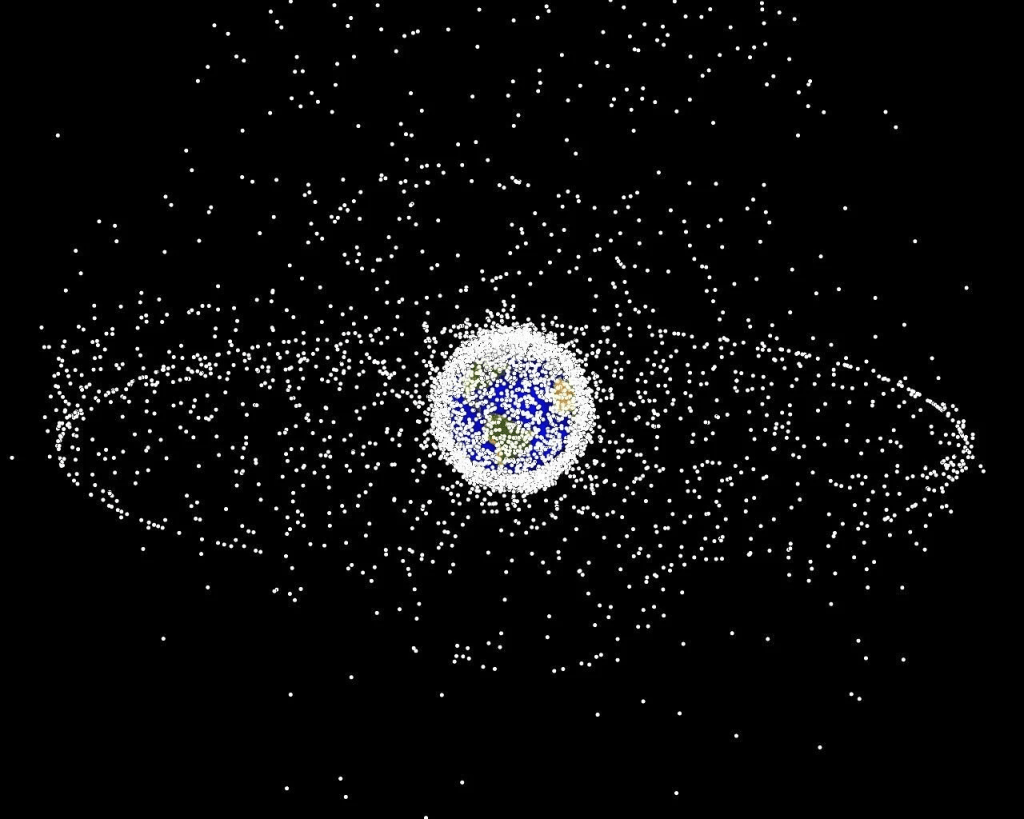
Nearly 5,900 tonnes of material is present in space, travelling at speeds of up to 18,000 miles per hour (NASA,2023–> see image above). Thus, as we learnt from Year 10 physics, the high mass and velocity results in a high momentum for the debris (p=mv). This creates a large impact force over a short time. A collision occurs, causing more fragments of debris. As these collide with one another, more particles are formed, and eventually, the majority of the LEO is filled with breakup debris.
This breakup debris is particularly dangerous for the functioning satellites and spacecraft around it. Space junk,sharpened and eroded from past collisions, has previously caused catastrophic tears and dents on the exterior spacecraft material. And with the large impact force mentioned earlier, can cause further harm to the interior.
Furthermore, satellites are endangered by space pollution. We commonly misconstrue satellites to just be useful for space exploration and weather forecasting, but we rely on satellites for so many of our now ‘bare necessities.’ Communication, social media, navigation and timing, banking and finance(just to name a few!)
Overall, space debris could take over the entire LEO through a scenario called ‘Kessler Syndrome.’ Remember the chain reaction of debris collisions we were talking about earlier? In 1978, NASA scientist Donald Kessler proposed that a tipping point of collisions would soon be reached. Then, without launching any further satellites, so many collisions would occur that a cloud of debris would form around the Earth. This would render the LEO unusable for satellites or space exploration.
He believed this would be a reality within 30-40 years and so, starts our countdown for our space debris clean-up mission.
Join us next time to learn what aerospace engineers are doing around the world to clean up our cosmic carpet? We will unpack active debris removal (ADR) technologies, so stay tuned!
If you have any questions, please feel free to contact us and we would love to hear your thoughts. Through an Extended Research Project on ‘Can Engineering Innovations Solve the Space Debris Crisis’ written and researched over several months by our Founder, we will aim to answer all your questions!

 queengineers.co.uk
Leave a comment