
The Ancient Science Behind the Scirocco Rooms
Hi everyone, and welcome back to Queengineers!
In our recent article, ‘The Engineering of Lost Civilizations,’ we explored how past engineers shaped the world and why their innovations still matter today. Learning from their ingenuity and problem-solving is essential—not just to honour their legacy, but because the key to advancing engineering lies in understanding their wealth of knowledge.
With this in mind, we are excited to feature a guest article by Sana Lamy, who takes us on an insightful journey through one such engineering example:the Scirocco Rooms…
Meet the writer
Hi, I’m Sana, an art history graduate from Canada. Through my studies of history, art, and languages, and philosophy, I’ve discovered my real passion for Renaissance era (around the 15-17th century) architecture. Today, I want to share with you a fantastic feat of ancient civil/structural engineering from 16th century Sicily, Italy: the Scirocco Rooms.
Ancient civilizations like the Greeks, Egyptians, and Mesopotamians were masters of harnessing water’s power in their architecture and technology. I’m inspired by ancient innovation, and I hope I can inspire you too to imagine how these ideas could influence the future of engineering and design; think sustainable hydraulic systems, eco-friendly buildings, architectural preservation, and more.
Discover the “Cool” Secrets of Sicily’s Scirocco Rooms
First, I should point out two things: first, a Scirocco Room is not a room in the
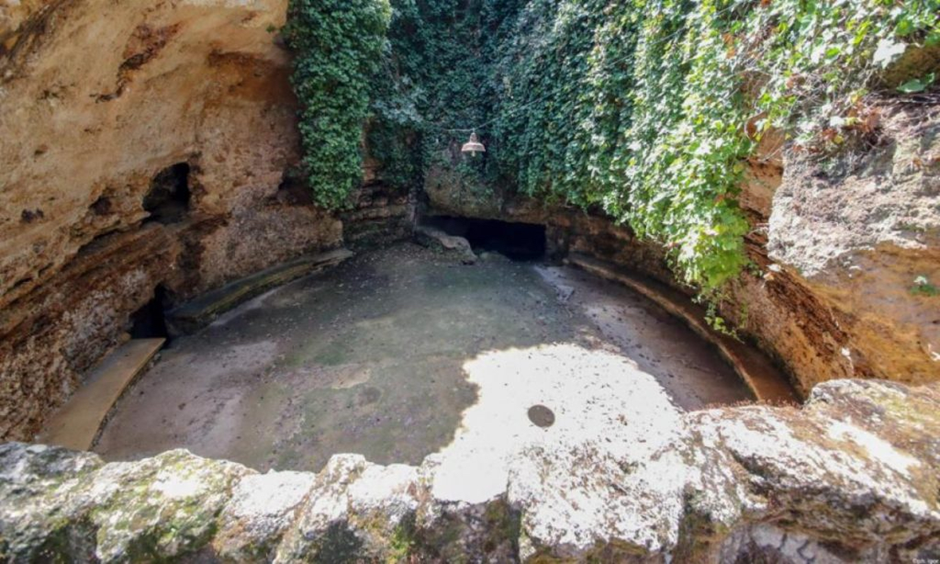
traditional sense you’re thinking (see the image below)… it’s actually a man-made cave located under a villa (or house). Second, these “rooms” are pretty cool (pun intended!)because they optimise the laws of physics to remove hot air and create a comfortable place to have dinner and socialise.
Open-air Gathering Space in Scirocco Room (“Room of Four Canne”)
Let’s dive into the fascinating history and ingenious engineering involved in the scirocco rooms of the city of Palermo, in Sicily, Italy. Imagine living in a hot, sunny place like Sicily without air conditioning. To escape the heat, they built these underground, named after a sweltering hot scirocco wind that blows from the Sahara desert all the way upto Spain, bringing temperatures up to 40+℃. Scirocco Rooms underground, were naturally cooler than the house above, like how a basement is cooler than the floors above in a house.
Wind-towers in Dubai
If you’ve ever been to Dubai in the UAE, you might have seen these structures… those are “wind-towers” and are also used in scirocco rooms! We’re going to explore how these work in scirocco rooms here but the concept is the same across hot and dry climates where these ingenious feats of engineering can still be seen.

First seen in the Ancient era architecture passive cooling in scirocco rooms takes
advantage of the natural properties of limestone, convection currents, and water to dissipate hot air without using any energy from outside sources. It’s like a natural air conditioner! Check out the diagram below for a visual summary of how “wind-towers” (a.k.a. “wind-catchers” and canals (qanat in Arabic) work:

Scirocco Rooms were also connected to a massive underground water network that provided water for irrigation, drinking, and even leisure activities. People from all over Europe would gather in these rooms to socialise and hang out, and Sicilians actually used these rooms right until World War I! These underground rooms were a game-changer, so imagine what we could use this design for today… but we’ll have more on that later.
STEM bits
Now let’s dive a bit deeper into the science, tech, engineering, and maths aspects of scirocco rooms. As mentioned, these underground chambers work with the natural properties of water, earth (it’s cooler when you dig down), and limestone (the material the cave is made of), and the laws of thermodynamics in physics to cool air/push out hot air.
Structural Components of Scirocco Rooms
Scientist and engineer Manfredi Saeli and engineer Enrico Saeli investigated the
scirocco room under Villa Naselli-Ambleri 2015. Thanks to them, we know that the principles of thermal conductivity, water evaporation, and convection currents all facilitate passive cooling. The central components of scirocco rooms are:
- a natural water source,
- one or multiple qanāt,
- long passageways or galleries, and
- a central gathering space.
The Limestone
Limestone, the terrain on which Palermo is built, is perfect for scirocco rooms.These rooms are built below ground, and because limestone has low conductivity, meaning it keeps heat out and cool air in, it’s like a natural air conditioner! It’s also semi-permeable, meaning it can absorb some of the water vapour (from evaporation),which cools the air even more.
The Wind-tower & Tunnels
You enter the scirocco room down a 3-meter staircase and into the 5x5m 2 space, with two “galleries” or tunnels, the Major and the Minor. These are 3 meters high and wide with openings above to let heat escape, and run 50 meters under the property in northwest and southeast directions. The Major Gallery ends in an 8×8.5m open-air gathering space pictured below: Room of Four Canne. The Round Fountain intersects the Major Gallery, and, above ground, there is a well from the Medieval-era in the same spot. You can see both in the pictures below:
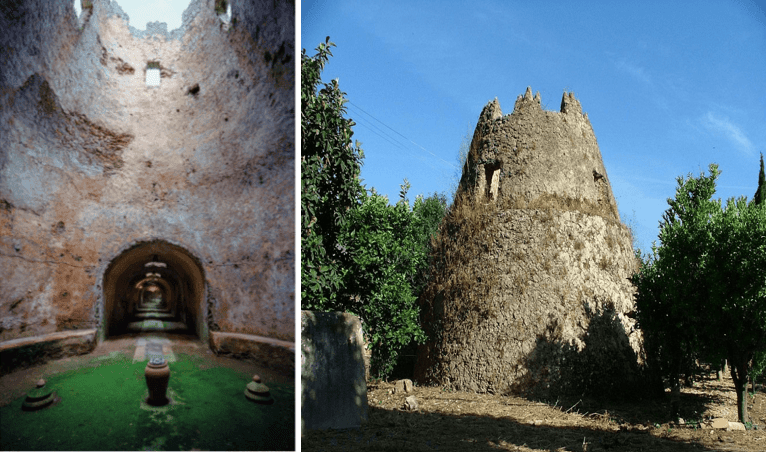
The Round Fountain (underground) and Well (above ground)
So what does this have to do with convection currents? When the scirocco wind
blows, it heats up the air in the Major and Minor Galleries, making it rise and escape through the seven openings in the ceiling. The “wind-tower” at the bottom of the well(where the Round Fountain used to be) helps to expel this hot air. As the hot air rises, cooler air from inside the building flows in to replace it, creating a natural circulation of air. This process is called convection. The cooler air then flows into the gathering space, the Room of Four Canne, keeping it ventilated and cool!
The Future of Eco-friendly Air
Conditioning?
The effectiveness of passive cooling in scirocco rooms was studied and, in a year
researchers recorded that temperatures inside were 2-4℃ lower than outside. The data also showed that the air inside was 5-10% more humid, making a huge difference in the dry 40℃ heat (see the bibliography to read more).
Today’s air conditioning units use a special liquid called refrigerant to push out heat.
Refrigerants aren’t great for the environment, unfortunately, and the machines don’t recycle very well. Consider how passive cooling and mechanical cooling compare. AC cools in a cycle of four steps:
- evaporation,
- compression,
- condensation, and
- expansion.
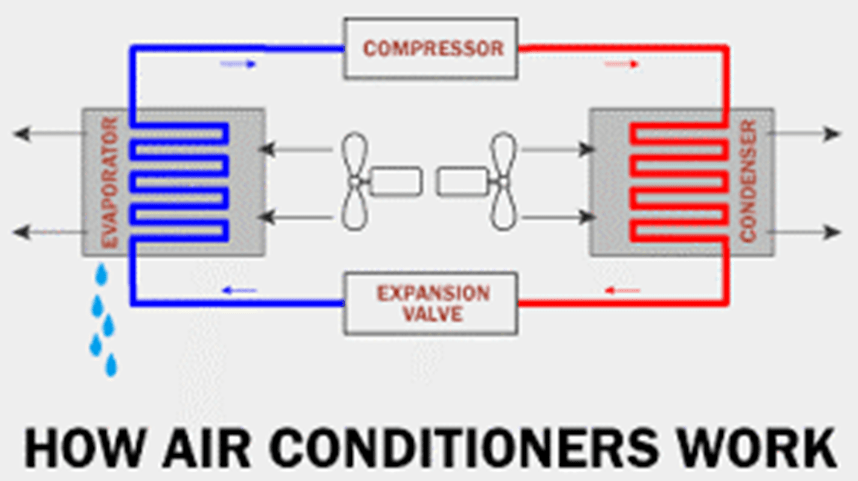
Air conditioning starts when hot air from the room flows over evaporator coils, which are filled with liquid refrigerant.As the refrigerant absorbs heat, it changes from a cool liquid to a warm gas.
The refrigerant then passes through the compressor(usually located outside) which squeezes it and increases both its pressure and temperature.
The hot gas moves outside to the condensor where heat is released to outside air. Finally, the refrigerant turns back into a liquid through the expansion valve and the cycle repeats…
A.C works by taking the heat out of the air inside the house and sending it outside.All of this also requires electricity, but passive cooling does it all through the laws of physics!
Air conditioning machines produce a negative impact on our environment with them causing around 3% of greenhouse gas emissions in 2022.And,with global warming, more people are purchasing them so the emissions will only increase.Whereas,little did we know, the solution to sustainable cooling was standing in front of us:the Scirocco rooms.
People of Yazd, Iran have relied on “Wind-Towers”, which use natural ventilation and cooling, for millennia. Scirocco rooms were used in southern Italy for about 400 years(1500s-1900s). By studying these ancient designs and engineering, we can learn to harness the power of nature and create sustainable structures. The principles of passive cooling could be applied anywhere, and maybe one day you’ll design eco-friendly buildings inspired by ancient STEM techniques?
Thank You
A huge thank you to Sana for this very insightful article on Scirocco Rooms!This blog post shows the beauty of engineering and how ancient innovations can continue to inspire us today.
The Scirocco Rooms are a testament to how early engineers went through creative problem-solving and developed an efficient structure that can still be seen in use today in Sicily and Dubai, amongst other places.
If you have any questions for Sana, please feel free to reach out on our contact page,we would be happy to pass them onto her.
Bibliography:
Based primarily on the research of Saeli and Enrico Manfredi, 2015. “Analytical studies of the Sirocco room of Villa Naselli-Ambleri: A XVI century passive cooling structure in Palermo (Sicily)”. Journal of Cultural Heritage (vol. 16, pp.344-351). https://www.sciencedirect.com/science/article/abs/pii/S1296207414000867 .
See also:
Firrone, Tiziana, Davide Carella, and Carmelo Bustino. 2019. “The Scirocco’s Chamber of Micciulla manor in Palermo”. In Le Vie dei Mercanti – XVII International Forum, edited by Carmine Gambardella, (17): 653-664. Naples & Capri, Italy: Gangemi Editore. https://iris.unipa.it/handle/10447/96572 . Accessed April 2, 2024.
On limestone conductivity:
Pestre T., Emmanuel Antczak, Franck Brachelet, Didier Pallix. (2022). “Multi-physical Characteristics of Limestones for Energy-Efficient and Sustainable Buildings Components”. Journal of Materials in Civil Engineering. 34(4), 1-22. https://univ-artois.hal.science/hal-03627225/document. Accessed April 2, 2024.
On wind-towers/wind-catchers:
Ahmadikia H., Moradi A. & Hojjati M. (2012). “Performance Analysis of a Wind-Catcher With Water Spray”. International Journal of Green Energy, 9(2), 160-173. http://dx.doi.org/10.1080/15435075.2011.622019. Accessed 2 April 2024.
Krebelj M., (2023). “The Wind-catchers of Yazd “. Medium. https://marjankrebelj.medium.com/the-windcatchers-of-yazd-0527648f168c
Image sources:
France24/AFP, 2023, https://www.france24.com/en/.
Saeli, Manfredi and Enrico. 2015 & 2022 https://www.sciencedirect.com/science; https://www.calameo.com/books/005240998dad2f876235a
US Department of Energy, 2025, https://www.energy.gov/energysaver/air-conditioning
 queengineers.co.uk
Leave a comment